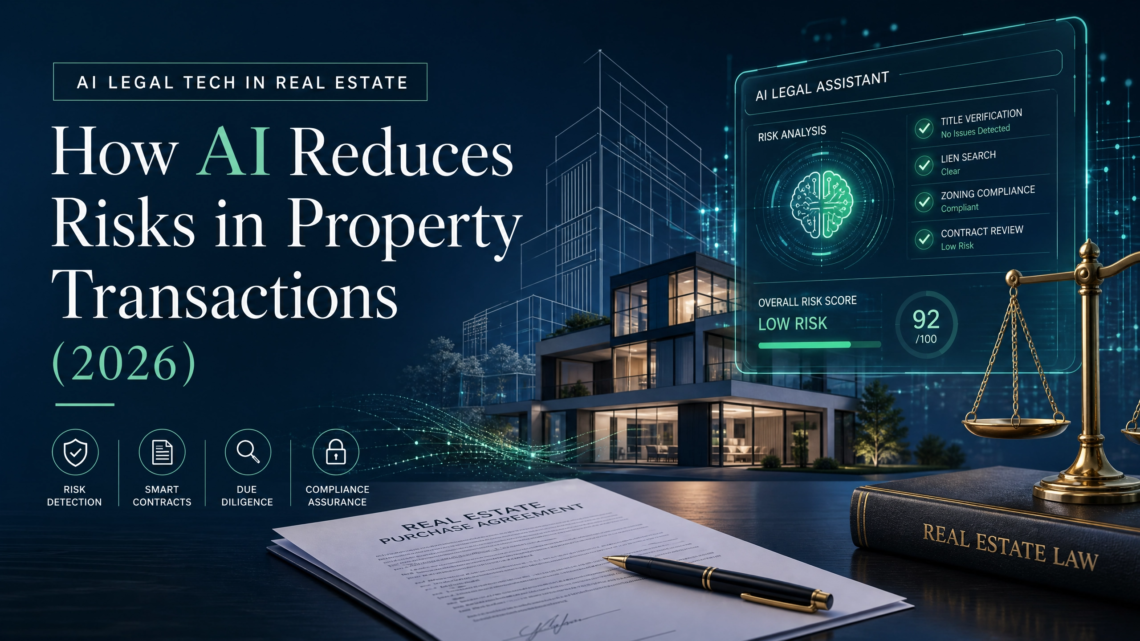
How AI Reduces Risks in Property Transactions (2026)
Date: May 2, 2026
Executive Summary
The real estate industry, traditionally reliant on extensive manual processes for legal documentation, is undergoing a significant transformation with the advent of AI Legal Tech. This article explores how Artificial Intelligence is revolutionizing contract automation, due diligence, and risk mitigation in property transactions. By leveraging advanced platforms like Kira Systems and Luminance, real estate firms, legal departments, and investors can drastically reduce time spent on document review, identify hidden liabilities, and ensure compliance across vast portfolios. Understanding and adopting these AI-powered legal solutions is crucial for enhancing efficiency, accuracy, and profitability in the complex real estate landscape of 2026.
Introduction: The Legal Labyrinth of Real Estate
Real estate transactions are inherently complex, involving a multitude of legal documents, contracts, and regulatory compliance checks. From purchase agreements and lease abstracts to due diligence reports and title reviews, the sheer volume of paperwork can be overwhelming, time-consuming, and prone to human error. This complexity often leads to increased costs, delays, and potential legal risks. However, the integration of Artificial Intelligence (AI) into legal technology (Legal Tech) is now offering powerful solutions to navigate this labyrinth, promising unprecedented levels of efficiency and accuracy .
AI for Contract Automation and Due Diligence
AI-powered legal platforms are fundamentally changing how real estate professionals handle contracts and conduct due diligence. These tools use machine learning and natural language processing (NLP) to read, understand, and extract critical information from legal documents at speeds impossible for human review.
Key Applications of AI Legal Tech in Real Estate (2026):
•Automated Contract Review: AI can quickly scan thousands of pages of contracts (e.g., lease agreements, purchase and sale agreements, loan documents) to identify specific clauses, terms, and conditions. This is invaluable for large-scale portfolio acquisitions or property management .
•Enhanced Due Diligence: During property acquisitions, AI accelerates the due diligence process by flagging potential risks, inconsistencies, or missing information in legal documents, such as environmental reports, zoning regulations, and tenant leases. This helps investors make more informed decisions and avoid costly surprises.
•Lease Abstraction: For commercial real estate, AI can automatically abstract key data points from complex lease agreements, including rent schedules, renewal options, common area maintenance (CAM) charges, and tenant obligations. This streamlines property management and financial reporting.
•Compliance Monitoring: AI tools can continuously monitor contracts and legal documents for compliance with evolving regulations, ensuring that real estate operations remain within legal boundaries and mitigating regulatory risks.
•Litigation Support: In cases of disputes, AI can assist legal teams by rapidly analyzing vast amounts of discovery documents, identifying relevant evidence, and predicting potential outcomes.
Leading AI Legal Tech Platforms for Real Estate
Several platforms are at the forefront of delivering AI-powered legal solutions specifically tailored for the real estate sector:
1. Kira Systems
Kira Systems remains the “gold standard” for contract analysis and due diligence in commercial real estate transactions .
•Focus: Primarily on identifying and extracting provisions from unstructured contracts and documents.
•Key Features (2026):
•Machine Learning Models: Pre-built and customizable machine learning models for common real estate clauses (e.g., assignment, subletting, indemnification, default).
•Smart Fields: Automatically identifies and extracts specific data points like dates, parties, and monetary values.
•Anomaly Detection: Flags unusual or non-standard clauses that might indicate risk.
•Integration: Seamlessly integrates with existing document management systems and workflows.
•Benefits for Real Estate: Drastically reduces the time and cost of due diligence, improves accuracy, and allows legal teams to focus on high-value tasks.
2. Luminance
Luminance is highly regarded for its ability to handle complex, multi-jurisdictional transactions and large, varied document sets under tight deadlines .
•Focus: Leveraging advanced pattern recognition and unsupervised machine learning to identify anomalies and key information.
•Key Features (2026):
•Unsupervised AI: Can analyze documents without prior training, making it highly adaptable to new types of contracts or legal frameworks.
•Language Agnostic: Capable of reviewing documents in multiple languages, crucial for international real estate portfolios.
•Document Comparison: Identifies changes and discrepancies between different versions of contracts.
•Workflow Automation: Streamlines the entire contract review process from ingestion to reporting.
•Benefits for Real Estate: Ideal for cross-border real estate deals, M&A due diligence involving property assets, and identifying subtle risks that might be missed by human review.
3. Spellbook (Emerging Player)
While Kira and Luminance dominate the enterprise space, Spellbook is gaining traction for its user-friendly interface and direct integration with Microsoft Word, making it accessible for real estate lawyers to automate drafting and review .
Reducing Risks and Enhancing Profitability
The adoption of AI Legal Tech in real estate offers several tangible benefits that directly impact risk mitigation and profitability:
•Minimized Human Error: AI systems are less prone to oversight than human reviewers, ensuring critical clauses and risks are not missed.
•Accelerated Deal Closures: Faster due diligence and contract review mean deals can close more quickly, reducing holding costs and increasing transaction velocity.
•Cost Efficiency: Significant reduction in legal fees and operational costs associated with manual document review.
•Improved Compliance: Consistent application of legal standards across all documents reduces the risk of regulatory penalties.
•Strategic Decision-Making: By providing rapid access to critical contractual data, AI empowers real estate professionals to make more informed strategic decisions.
Conclusion: The Indispensable Role of AI in Real Estate Legal Operations
In 2026, AI Legal Tech is no longer a luxury but a necessity for any real estate entity aiming for efficiency, accuracy, and risk reduction. Platforms like Kira Systems and Luminance are setting new benchmarks for how legal due diligence and contract management are conducted. By embracing these intelligent tools, real estate companies can transform their legal operations from a bottleneck into a strategic advantage, ensuring smoother transactions, stronger compliance, and ultimately, greater profitability.
Call to Action (Affiliate Section)
Ready to streamline your real estate legal operations and mitigate risks with cutting-edge AI? Explore the leading platforms:
•Kira Systems: Revolutionize your contract review and due diligence process. [Link to Kira Systems Affiliate Program/Website]
•Luminance: Master complex, multi-jurisdictional real estate transactions with advanced AI. [Link to Luminance Affiliate Program/Website]
Invest in AI Legal Tech today to secure your competitive edge in the real estate market.
References:
[1] Summize. (2026). 2026 Legal Tech Trends: AI, CLM and Smarter Workflows.
[2] The AI Consulting Network. (2026). Best AI Tools for Real Estate Attorneys 2026.
[3] Viewpoint Analysis. (2026). Legal AI Software Options 2026.
[4] ViewSpectra. (2026). Luminance vs Kira Systems: Which AI Is Better for Due Diligence?.
[5] Spellbook. (2026). 6 Best AI Tools for Real Estate Lawyers in 2026.